What Our Customers Wish They'd Known Before Their Patio Install
By We Do Hardscape LLC · ROC 354091 · October 29, 2026 · 6 min read
Our reviews do not document customer regrets. This is patio-planning advice guided by real feedback, not invented wish-they-had-known testimony.
Our published reviews do not document customer regrets or say what customers wish they had known before their patio installations. This article is planning advice guided by real reviews, not a collection of invented wish-they-had-known testimony. What the reviews do discuss includes communication, attention to detail, and bringing a backyard vision to life. We can use those themes to suggest better questions before construction without assigning anyone an experience they did not describe. For a Phoenix patio, the most useful questions connect your design preferences to summer exposure, furniture layout, drainage, installation details, and the written scope.
Turn praise for communication into specific planning questions
Nicholas Downey writes: "PJ and his team did an excellent job on my pavers. PJ was great to work with. He is beyond professional and great with communication." That is a statement about his experience. It does not mean he had a communication problem beforehand or later wished he had asked different questions. Our planning advice is to make communication practical before work begins. Ask who your contact will be, how you will review material choices, and how any proposed change will be documented. Tell us about pets, gate access, deliveries, and the times you need a clear route through the yard. If you have an event on the calendar, mention it before discussing timing. Ask what could affect the schedule, including weather, materials, and applicable approvals. In Arizona, summer conditions and monsoon storms deserve a realistic conversation. Clear questions are useful even when everyone is getting along. They help turn a general sense of confidence into a shared understanding of the work.
Translate your backyard vision into a layout you can test
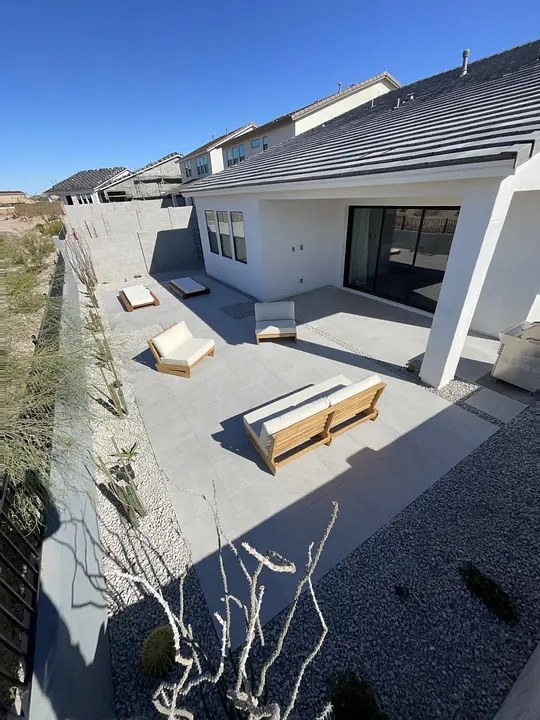
Wendy Bartley's review describes hiring us again after an earlier experience and praises communication and attention to her backyard vision. We should not turn that praise into a claim that she previously chose the wrong layout. The planning lesson we draw is simpler: explain what the yard needs to do, not just what it should resemble. Before choosing a patio footprint, mark the proposed edges with a hose or removable markers. Set out your table and chairs, or use their actual dimensions. Pull chairs back as if people were seated. Walk from the house to the grill, gate, and pool without taking shortcuts through the furniture. Repeat the exercise at your normal outdoor hours. A dining area that looks spacious at noon may sit in direct western sun at dinner. A narrow route may become awkward when someone carries a tray. These checks do not require a finished design. They give us concrete information to discuss before the layout becomes an installation decision.
Consider heat and shade before committing to a surface
None of the reviews cited here documents a customer regretting a hot patio. Heat planning is our advice because Phoenix conditions make it important, not because we are attributing an unreported complaint to a customer. Pavers, stone, concrete, and artificial turf can all become hot in direct sun. Look at the relationship between the surface and the shade rather than expecting a material to solve summer comfort alone. Lighter colors may help reduce solar heating compared with darker alternatives, but finish, exposure, and site conditions also matter. Samples viewed outdoors are more informative than a small screen image. Track where shade actually falls during the hours you want to sit outside. An open-lattice pergola does not provide the same coverage as a solid cover, and a high roof may not block low afternoon sun. Ask about the proposed structure's specific coverage. Plan around early mornings, evenings, and cooler seasons too, while recognizing that shade does not make extreme heat safe.
Ask about the details you will not see in the finished photo
Stacie R. writes: "The attention to detail and craftsmanship were outstanding, every cut, seam, and placement was done with precision." That supports a discussion of visible workmanship. It does not establish the hidden construction details of her project or prove how every future installation will perform. For your own patio, ask how the proposal addresses the existing ground, preparation, finished elevations, edges, and water movement. These are site-specific questions. Do not assume one base detail or drainage solution belongs in every Phoenix yard simply because it appeared in another project. Show us where water collects after a storm, where downspouts discharge, and whether existing paving has settled. Identify nearby doors, irrigation components, utility access, and pool equipment. Those observations can reveal issues worth investigating before surfaces are selected. A photo of the finished patio will not explain all of that work. Your planning conversation and written scope should make the relevant details easier to understand.
Use the quote to confirm what you are actually choosing
Reviews can help you decide what to ask, but they do not replace a project-specific agreement. A customer's positive experience does not establish your price, schedule, warranty, or included work. Read those details for your own project and ask about anything that remains unclear. Our stated promise is: "No pressure. Clear prices. We listen first." We also state: "At the walkthrough we repeat back what you asked for, and that summary goes at the top of your quote." Use that summary as a check. Does it describe the seating area, routes, materials, and priorities you discussed? Are removal, preparation, edges, finishing, and any additional features clear? Where pricing needs confirmation, do not treat an unknown rate as something an instant calculator can resolve. Bring your questions to a $150.00 in-person consultation, including drive time and a one-hour walkthrough, then consider the written quote without pressure. Good preparation is not about predicting regret. It is about making an informed choice before the work starts, using your own yard rather than imagined customer stories.
Frequently asked questions
Did customers actually say they regretted their patio choices?
No. The published reviews used for this article do not document regrets or wish-they-had-known statements. We are not claiming otherwise. The title introduces a planning topic; the advice comes from considering themes in real feedback alongside practical Phoenix design questions. Any review quotation is the customer's actual wording, not a reconstructed interview or an invented lesson.
What should we bring to a patio walkthrough?
Bring a few reference photos, approximate furniture dimensions, your main activities, and any budget or timing constraints. Photos of standing water after rain can also help. Tell us which parts of the yard become uncomfortable in afternoon sun. You do not need a complete design, and identifying questions is just as useful as arriving with firm material choices.
Can choosing travertine eliminate summer heat concerns?
No surface should be treated as a guarantee of comfortable barefoot use in Phoenix summer sun. Color, finish, exposure, and shade affect the experience. Compare samples outdoors and discuss the whole layout, including shaded routes and seating. Check surfaces before children or pets use them, and remember that a more comfortable surface does not remove the risks of extreme heat.
How can we compare quotes without comparing only the total?
Check whether the proposals cover equivalent removal, preparation, materials, edging, finishing, drainage work, and other requested features. Read what is excluded and ask about unresolved items. Confirm timing and any offered warranty separately rather than inferring them from a review. A lower or higher total means little until you understand which work and responsibilities each proposal actually includes.
Sources and further reading
Sources checked October 29, 2026. Product specifications, contractor offerings and local requirements can change.