Why Pavers Sink in Phoenix Yards (and How a Proper Base Prevents It)
By We Do Hardscape LLC · ROC 354091 · October 29, 2026 · 6 min read
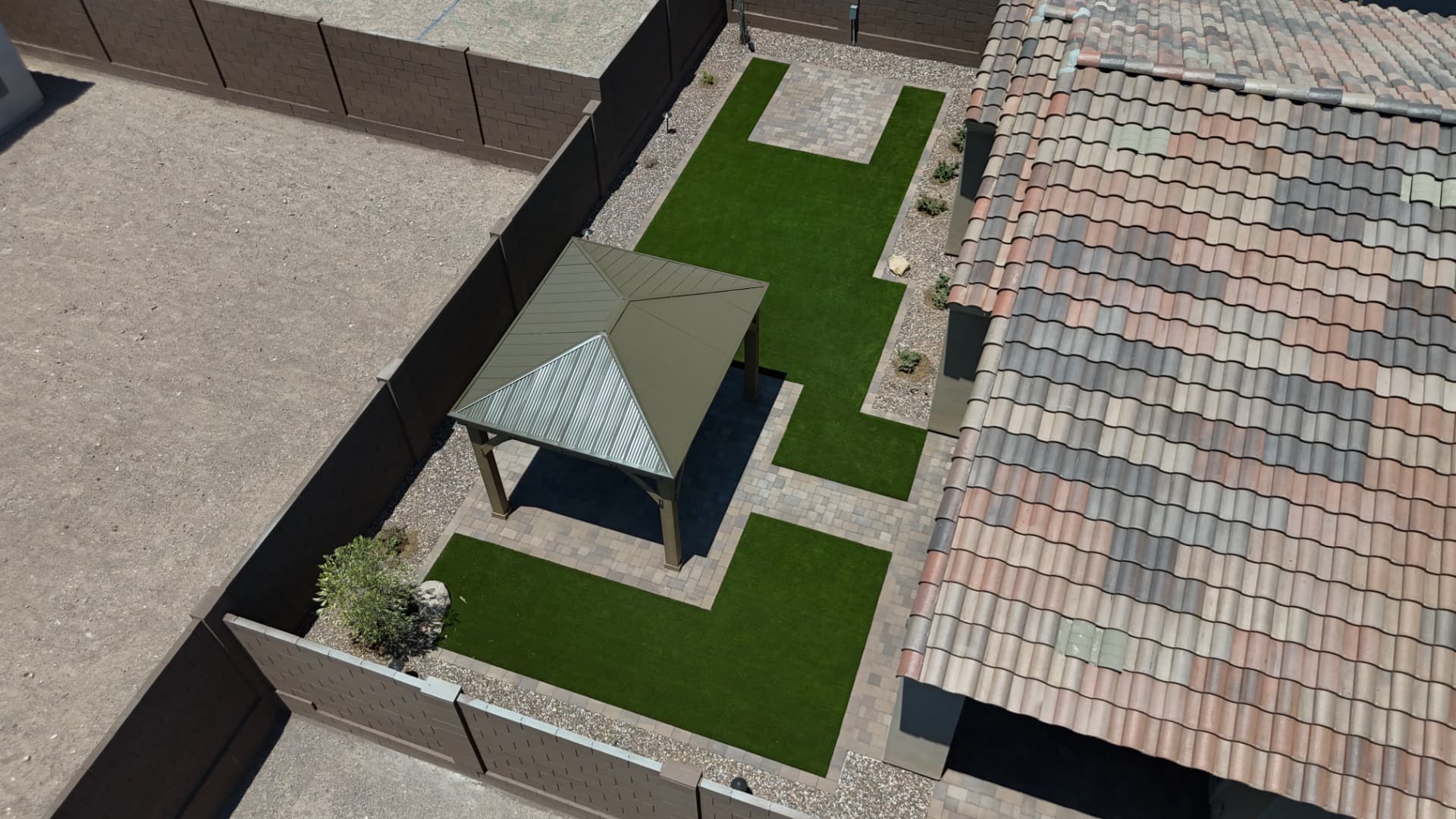
Sunken pavers usually point to a problem beneath the surface. Soil, water, compaction, and site-specific base design all matter.
Pavers sink in Phoenix yards when the support beneath them settles, shifts, or loses material, often with water contributing to the problem. A properly designed and installed base reduces that risk by addressing the actual soil, drainage, and expected use rather than relying on a standard thickness for every yard. The paving surface is only the visible part of the assembly. When a low spot appears, resetting the top layer without understanding what happened underneath can leave the original cause in place. We start with the site and the pattern of movement, not an assumption that every uneven patio needs the same repair.
Sinking pavers are a symptom, not a complete diagnosis
A dip in a patio can have several explanations. Previously disturbed soil may settle. Supporting material may not have been prepared consistently. Water may carry fine material away or collect where the assembly cannot handle it. A leaking irrigation line can create a localized problem that looks different from broad settlement across a recently built yard. The shape and location of the movement provide clues. A depression near a utility trench raises different questions from movement along an unsupported edge. Unevenness beside a downspout suggests a reason to trace runoff. None of those observations proves the cause by itself, but each helps focus an inspection. We also distinguish sinking from other movement. Raised areas near roots, displaced edges, and displaced units around a drain are not necessarily the same failure. Calling every uneven spot a base problem can lead to an incomplete repair. The first task is to understand what moved, where it moved, and whether the condition is continuing.
Phoenix soils and caliche require a site-specific plan
Phoenix-area yards do not all have the same ground conditions. Native soil, imported fill, past excavation, landscaping changes, and construction history can vary across one property. A surface that feels firm during a walkthrough does not reveal everything about the material below it or how that material will respond when wet and loaded. Caliche is another reason to investigate rather than assume. A cemented layer may complicate excavation and influence how water moves, but its presence does not automatically create a suitable, uniform foundation for paving. Its continuity, condition, and relationship to surrounding soils matter. Treating every hard layer as ready-made support can overlook important site differences. There is no responsible universal base thickness for all of those situations. The appropriate assembly depends on the subgrade, intended loads, selected paving system, drainage, and applicable requirements. Where conditions are uncertain or movement is significant, geotechnical or engineering input may be needed before an installer can define a reliable scope.
A proper base is an assembly, not just a depth
When homeowners compare proposals, base depth is an easy number to notice. It is not the whole design. A supporting assembly also depends on suitable materials, preparation of the underlying ground, controlled placement, appropriate compaction, and compatibility with the chosen paver system. Adding more material over an unresolved problem does not automatically produce a better result. The anticipated use matters too. A pedestrian patio and an area carrying vehicles do not place identical demands on the ground beneath them. Access for construction equipment, nearby structures, and transitions to existing surfaces can also affect how the work is planned and completed. We want a proposal to explain what the assembly is intended to support and how site conditions will be addressed. That explanation is more meaningful than a fixed thickness presented as suitable everywhere. Installation should follow the relevant product requirements and the project design. If excavation reveals unexpected fill, soft areas, or other unsuitable conditions, those findings need evaluation rather than concealment.
Drainage and edge support help keep the surface stable
Even a carefully prepared base can be undermined by an unresolved water problem. Roof runoff, irrigation, pool-related water, and storm flow should all be considered. The question is not simply whether the patio appears sloped. Water needs an appropriate route through the site without creating erosion, collecting against structures, or being redirected onto a neighboring property. Conventional paver joints should not be treated as proof that a patio is a designed permeable system. A permeable installation is a distinct assembly with its own site and maintenance requirements. Assuming that rain will disappear between ordinary pavers can leave the supporting materials exposed to conditions the installation was not designed to manage. Edges also matter because the paving needs lateral restraint appropriate to the system. Movement at a boundary can affect adjoining units and joints. Drainage, edge support, and the underlying assembly should therefore be reviewed together. Repairing only the visible low spot may miss the conditions that allowed the surface to move.
Repair the cause before resetting the pavers
A repair should begin by documenting the affected area and checking nearby water sources, edges, drains, and previous excavation. Lifting units can reveal useful information about the bedding and supporting materials, but the extent of investigation should match the problem. Widespread movement or recurring settlement may require a broader assessment than a small isolated depression. If a leak, drainage defect, or unsuitable underlying material is identified, the repair scope should address it before the surface is restored. Reusing sound pavers may be possible, but that does not make the hidden work optional. Simply topping up the low area can improve appearance temporarily while leaving the cause untouched. Ask for a clear description of the proposed correction, the assumptions behind it, and what happens if unexpected conditions are uncovered. No honest installation promise can eliminate every future ground or water issue. The practical goal is a site-appropriate assembly, a functioning drainage approach, and a repair that responds to evidence instead of repeating the original shortcut.
Frequently asked questions
How thick should the base be under pavers in Phoenix?
There is no single thickness that suits every Phoenix yard. The design depends on soil conditions, expected loads, drainage, the paving system, and applicable requirements. Caliche or apparently hard ground does not remove the need for evaluation. Ask how the proposed assembly was selected for your site rather than judging a proposal by one depth number alone.
Does caliche mean we can skip base preparation?
No. Caliche can vary in condition and continuity, and it may affect excavation and water movement. Finding it does not prove that the entire paving area has uniform, suitable support. The underlying conditions and intended use still need assessment. Preparation and any additional investigation should follow the site-specific design, not an assumption that hard ground needs no attention.
Can sunken pavers be repaired without replacing the whole patio?
Sometimes. A localized issue may allow sound units to be lifted and reused after the underlying cause is corrected. Widespread settlement, recurring movement, or drainage problems can require a larger scope. An inspection should establish whether the visible depression is isolated or part of a broader issue before anyone promises that a small surface repair will last.
Why do pavers sink near sprinklers or roof runoff?
Repeated or concentrated water can expose weaknesses in the supporting assembly, contribute to soil changes, or move fine material. A nearby sprinkler or downspout is a clue, not a diagnosis. Check for leaks, erosion, and the actual runoff path. Correcting the water source or routing may be necessary alongside rebuilding the affected support and resetting the paving.
Sources and further reading
- University of Arizona Extension: Managing Caliche in the Home Yard
- CMHA: Maintenance of Interlocking Concrete Pavements
Sources checked October 29, 2026. Product specifications, contractor offerings and local requirements can change.