A Phoenix Backyard Sinkhole After the November Rain: What Your Drainage Is Trying to Tell You
By We Do Hardscape LLC · ROC 354091 · November 5, 2026 · 4 min read
After the Nov 1 rain, a Phoenix backyard sinkhole nearly 6 feet deep swallowed a man and a truck. Here is what that means for drainage in Valley yards, the warning signs to watch for, and how a French drain helps.
After the rain on Nov 1, a Phoenix backyard sinkhole nearly 6 feet deep swallowed a man and a truck. The man was rescued. It is the kind of story that sounds extreme until you have walked a Valley yard after a big storm and seen water sitting where it should have drained away.
You can read the news report here: https://www.azcentral.com/story/news/crime-public-safety/metro-phoenix/2026/11/02/man-rescued-from-sinkhole-in-phoenix-backyard-caused-by-rain/92565852007/
Drainage is not optional here. It is the difference between a yard that handles a storm and a yard that starts to fail under it.
What happened
Heavy rain saturated the ground, and the ground gave way in one spot. That is the short version. The longer version is the part homeowners should pay attention to, because the same conditions show up in a lot of Phoenix yards: a lot of water in a short time, soil that does not drain fast, and nowhere good for that water to go.
Flood warnings were still posted in parts of Arizona through Saturday after the Nov 1 rain. Even after the sky clears, low spots and saturated ground can stay risky for days.
Why this happens in the Valley
Phoenix does not get rain the way a lot of places do. We get long dry stretches, then a monsoon or a winter storm dumps a lot of water fast. The ground can be hard and dry on top, with caliche underneath that water does not move through easily. So water runs, pools, and finds the low spot.
Add in a yard that is graded flat, or graded toward the house, or a downspout that dumps right next to a patio, and you have water sitting against structures and soaking the same area over and over. Do that enough times and the soil underneath starts to shift. Pavers sink. Concrete cracks. Low spots get lower.
5 warning signs your yard drainage is failing
You do not need a sinkhole to know you have a problem. Look for these after the next rain:
- Standing water that is still there a day later. A puddle that hangs around is water with nowhere to go.
- Soggy spots that never seem to dry out, even when the rest of the yard is dry.
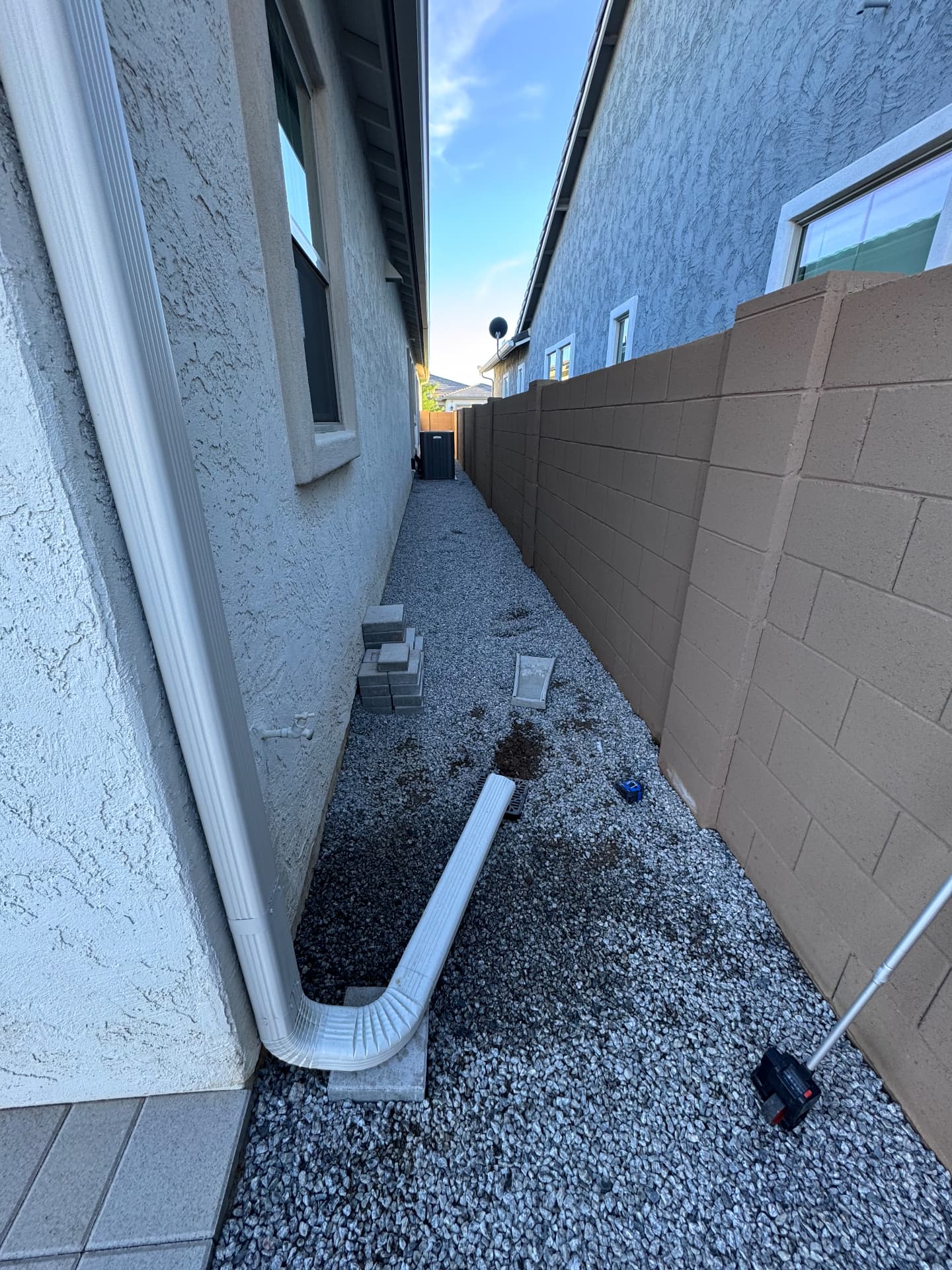
- Water pooling against the house, a block wall, or the edge of a patio.
- Mulch, gravel, or dirt washed into piles, or small channels cut through the yard.
- Pavers that are sinking, tilting, or rocking, or concrete with new cracks.
If you see more than one of these, do not wait for the next storm to confirm it.
What a French drain actually does
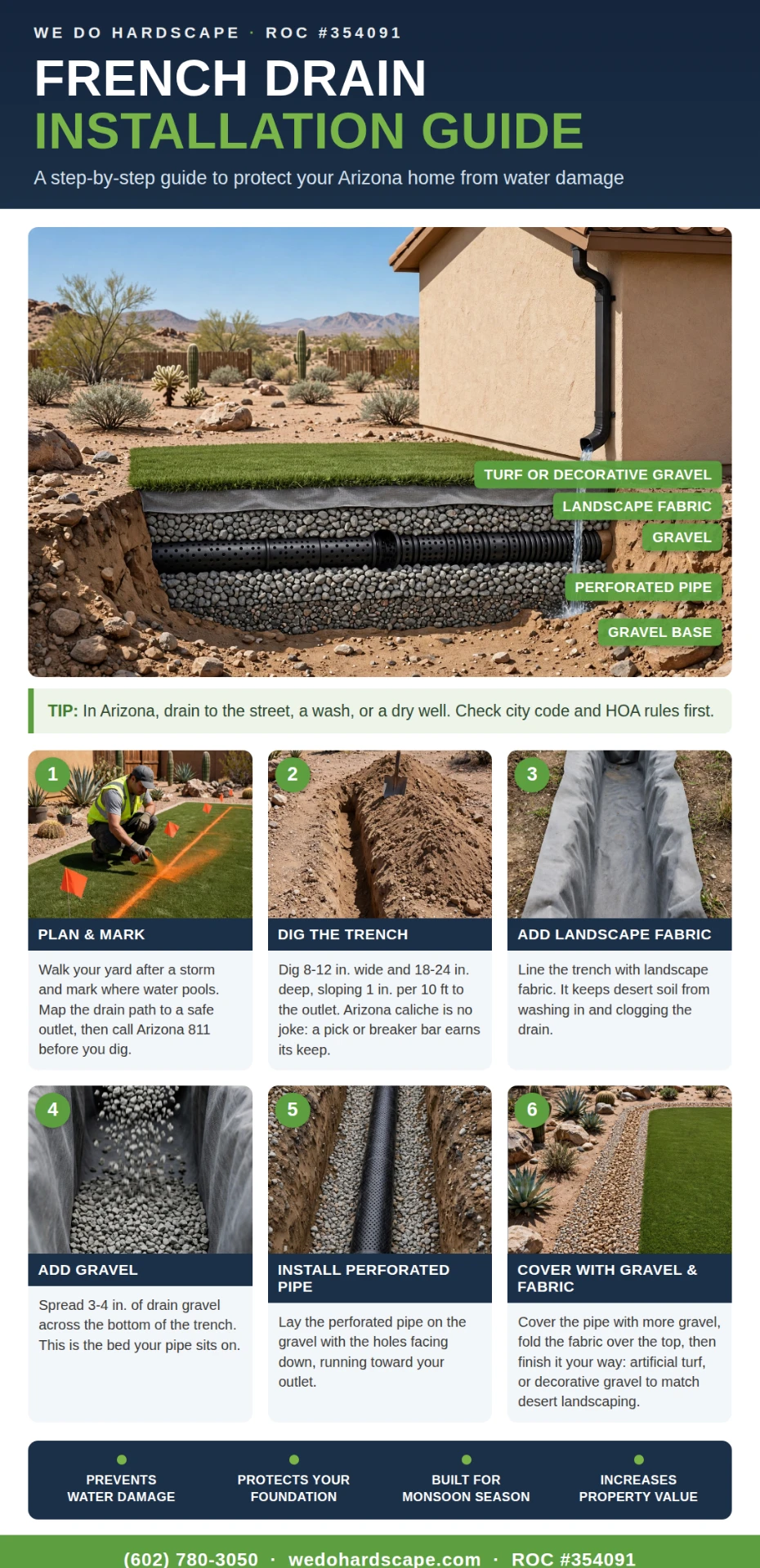
A French drain is simple, and that is why it works. It is a perforated pipe set in a gravel trench. Water collects in the gravel, enters the pipe, and the pipe carries it away from the problem area to a safe outlet.
In Arizona, a few details matter:
- Call Arizona 811 before you dig. You need to know what is underground first.
- Caliche is hard digging. Plan for it, do not pretend it is not there.
- The drain has to outlet somewhere real, like the street, a wash, or a dry well. Check your city code and your HOA rules before you pick the outlet.
- The finish on top can be turf or gravel instead of grass. That fits a lot of Valley yards better, and it keeps the drain working without a lawn sitting on top of it.
I made a step by step French Drain Installation Guide for Arizona yards that shows the cross section and the six steps. Ask me about it if you want a copy, or look for it with this post.
What to check after a big rain
Walk your yard the morning after a storm. It takes five minutes and it tells you the truth.
Start at the house and walk out. Look where water sat overnight. Check the low corners, the side yard, and anywhere a downspout lands. Look at your patio edges and your turf. If you see standing water, take a photo and note where it is. That photo is useful later when you are talking to a contractor, because it shows the problem at its worst.
Do the same check a day later. If the same spots are still wet, that is your answer.
What to do if you see these signs
Do not just add more rock to the low spot. Rock on top of a drainage problem hides it for a while, then the problem comes back.
The fix starts with figuring out where the water comes from, where it goes now, and where it should go instead. That means grading, outlets, and a drain that is sized for your yard, not a guess.
If your yard held water after the Nov 1 rain, or if you are seeing any of the signs above, start with a free discovery call. We will walk your yard, look at how water moves through it, and talk through what it would take to fix it right.
PJ SparksWe Do Hardscape LLC, ROC 354091Phoenix, Arizona, (602) 626-0409